Models & Markets Update: September 2026
Register here for next month’s call: Thursday, October 15th 2026, 1 p.m. ET.
Key Takeaways
- Prepayment models continue to track realized speeds well across Fannie, Freddie, and Ginnie collateral, with modeled CPRs running only modestly ahead of actuals
- Non-QM Credit Model 7.1 is getting an October 4th update that broadens the default definition (60+ days delinquent that liquidates = default), roughly doubling measured default rates — though re-estimated severity should offset much of that on a total-loss basis
- The planned “v4.0” prepayment model rebuild has been re-sequenced: an incremental v3.9 release (better FICO/LTV/loan-size controls, FHA/VA accuracy, re-estimated turnover) now comes first, with beta testing in early Q1 2027; the full structural rebuild slides to a Q4 2027 beta
- New deployment options — a Python wheel now in beta, with a REST API/Docker container, Windows DLL, and AWS Batch support to follow — will let clients run RiskSpan’s models inside their own infrastructure, with an MCP/AI connector on the longer-term roadmap
- The Fed funds rate looks set to stay elevated through 2026-2027, the 10-year Treasury is at its highest level since roughly 2007 (~5%), and mortgage rates could push above 7.5% by mid-2027 — a higher-for-longer environment that should keep housing inventory tight but limit the risk of a significant home price decline
This month’s call covered prepayment model back-testing, a deep dive on the model development roadmap (Non-QM Credit Model 7.1, the re-sequenced prepayment model plan, and new deployable model options), and the latest macro and housing picture. Janet Joswick, RiskSpan’s Head of Product, presented in place of Divas Sanwal this month.
You can read the recap below or click here for the entire recording.
Prepayment Model Back-Testing
Modeled CPRs continue to track observed speeds closely across both agency and Ginnie Mae collateral, with model results running only slightly fast versus actuals in the most recent observations. The full interactive backtesting dashboards — with additional cohort and cut options — are available in the RiskSpan platform under RS Insights.
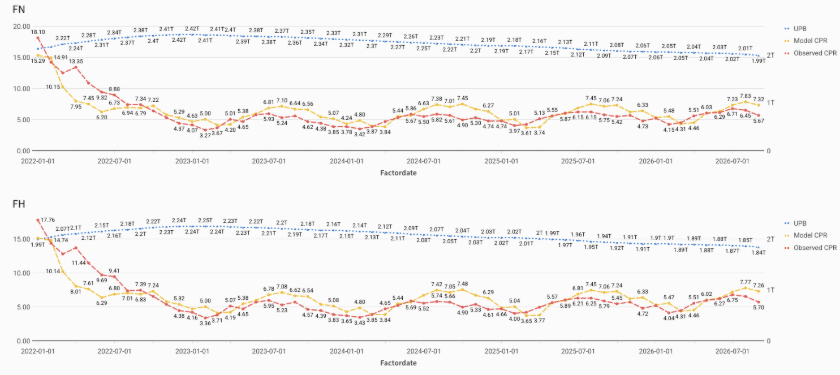
FN/FH WAC 5.5 and Below — Modeled vs. Observed CPR
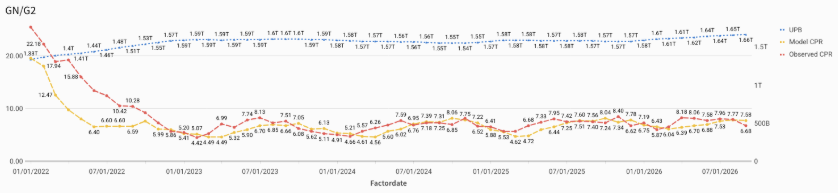
GN/G2 WAC 6 and Higher — Modeled vs. Observed CPR
Model Roadmap Updates
Non-QM Credit Model 7.1
An update to Credit Model 7.1 rolls out on October 4th. The headline change is a simplified default definition: any loan that reaches 60+ days delinquent and liquidates will now be flagged as a default, replacing a more nuanced (but harder to apply consistently) CoreLogic/Cotality-based definition. The change only affects late-stage transition rates (60→90, foreclosure, REO→default), but it roughly doubles measured default rates across documentation types.
Loss severity is being re-estimated in parallel, which is expected to partially offset the higher headline default rate on a total-loss basis — though the team is still working through how to model liquidations straight out of REO, where observed severity is frequently zero. Also landing in this release: prepayment penalty fees will flow through to final cashflows, which matters most for DSCR loans. Securities support for the credit model (currently whole-loan only) is targeted for December.
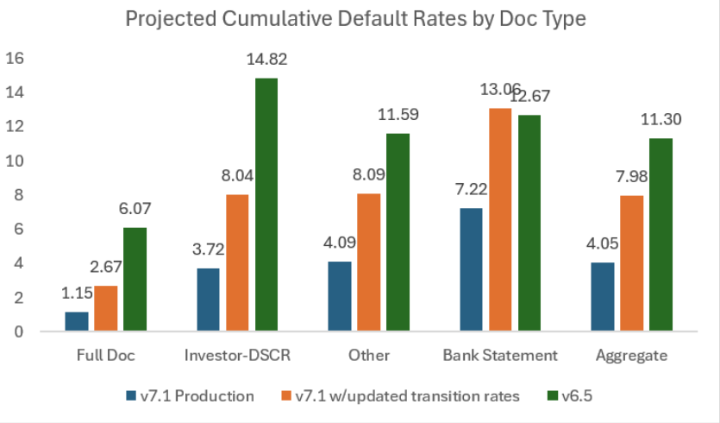
Projected Cumulative Default Rates by Doc Type: v7.1 Production vs. Updated Transition Rates vs. Legacy v6.5
Prepayment Model: Plan Shifted
Based on client feedback, RiskSpan has re-sequenced its prepayment model plans. Rather than moving straight to the full structural rebuild originally envisioned as v4.0, a faster, incremental v3.9 release will come first, building on the existing 3.8 agency model. Key improvements include additional FICO/LTV/loan-size controls, better floor and override controls, improved FHA-vs-VA accuracy within the Ginnie model (a frequent client pain point), and re-estimated turnover using post-COVID and recent jumbo-loan data. Beta testing is targeted for early Q1 2027, with full production shortly after.
The larger structural rebuild — now positioned as v4.0, with dedicated sub-models for curtailment, buyout, and cash-out — is still planned, with beta testing now targeted for Q4 2027 and production release in H1 2028. Clients interested in the v3.9 beta are encouraged to reach out to the RiskSpan team.
Deployable Model — Coming to Beta
RiskSpan is piloting a standalone, deployable version of its models for clients who want to run them inside their own infrastructure rather than through the platform UI or API. First out: a Python wheel (pip-installable, no server or network hop), already in beta with one client. On the roadmap: a REST API/Docker container, a Windows DLL for native C/C++ integration, and AWS Batch support. Further out, RiskSpan is also exploring an MCP connector that would let users run projections and calibrations conversationally through Claude or other AI tools, without writing code. Clients with use cases for model access outside the platform are encouraged to reach out.
Macroeconomic Update
The Fed funds rate is expected to stay elevated, with CME FedWatch data showing the current 375–400 bps range likely moving to 400–425 bps by year-end; a rate cut looks unlikely through 2026–2027.
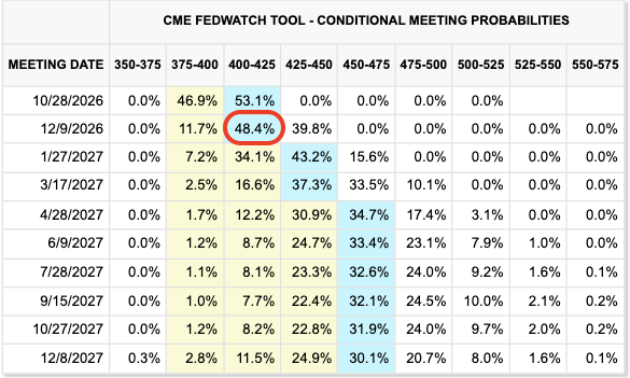
CME FedWatch Tool — Conditional Meeting Probabilities
The Treasury curve has shifted up in an almost parallel move over the past month, with the 10-year around 5% — its highest level since roughly July 2007.
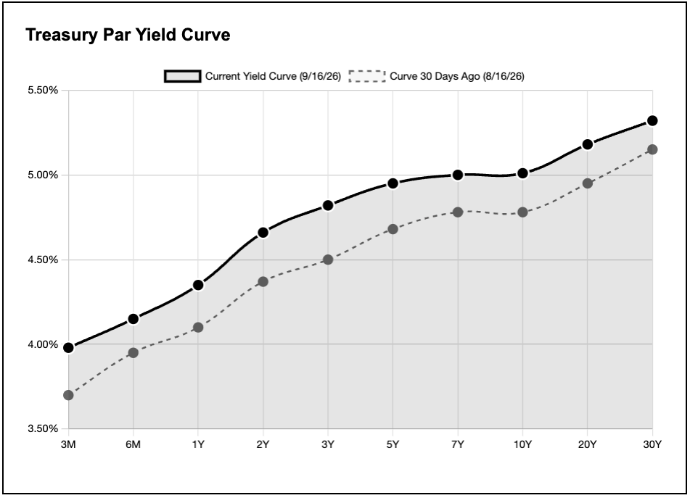
Treasury Par Yield Curve: Current vs. 30 Days Prior
Market consensus forecasts have the 10-year Treasury climbing above 5.4% in 2027, with 30-year mortgage rates potentially exceeding 7.5% by mid-2027. Mortgage rates have already moved sharply higher in recent weeks, with Mortgage News Daily quoting 7.24% as of September 16th.
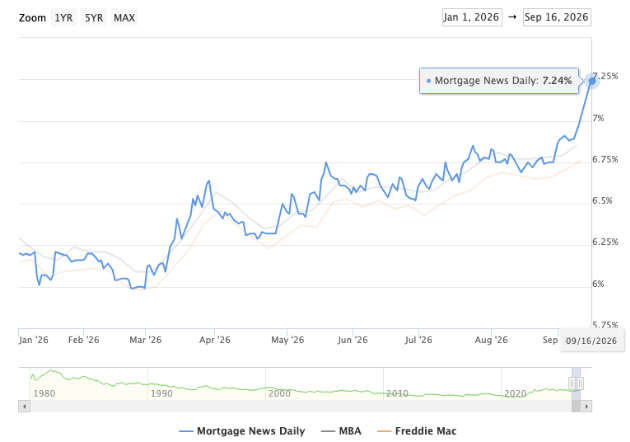
30-Year Fixed Mortgage Rate, Trailing 2 Years (Mortgage News Daily / MBA / Freddie Mac)
For housing, the combination of persistently high rates, negative homebuilder sentiment (fewer housing starts, less incentive spending), and low existing-home inventory — owners remain reluctant to give up lower-rate mortgages — should keep turnover and supply constrained.
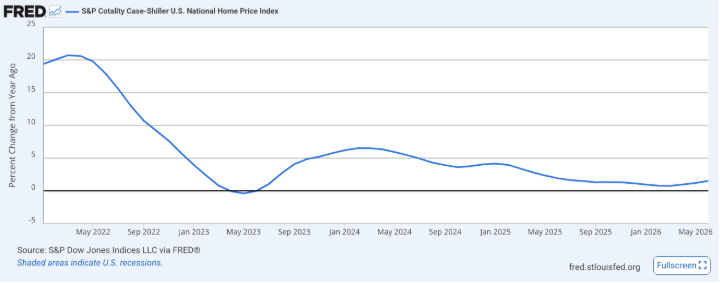
S&P Cotality Case-Shiller U.S. National Home Price Index, YoY % Change
RiskSpan’s view: that inventory scarcity should limit the risk of a significant home price decline, even as affordability stays stretched and core inflation remains elevated despite continued Fed intervention.
We continue to add additional analytics reports on the RiskSpan Platform. Please visit www.riskspan.com to request access.
As always, please feel free to contact us to discuss or learn more.